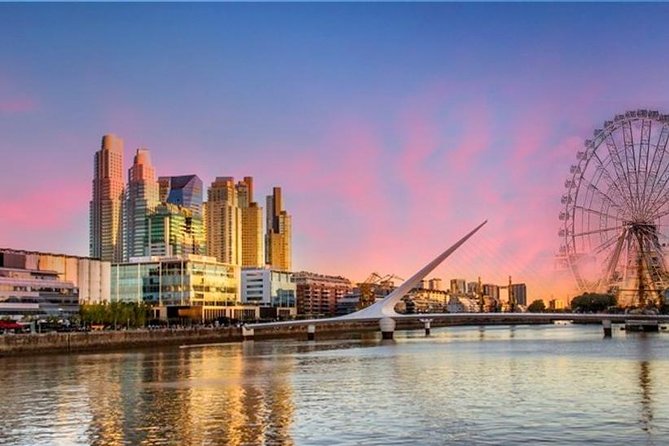
Across the Río de la Plata — the wide, brown estuary that separates Argentina from Uruguay — sit two cities that make for one of travel's most interesting comparisons. Buenos Aires, the sprawling, restless, magnificent Argentine capital. Montevideo, the compact, relaxed, quietly beautiful Uruguayan capital. They are two and a half hours apart by ferry and separated by an entire world in atmosphere, scale, and character.
Many travellers to the Southern Cone visit both. But if you have limited time, or are trying to decide which to base yourself in, or simply want to understand how the two compare before you book, this guide gives you everything you need.
Scale and First Impressions
Buenos Aires is a megacity. The Greater Buenos Aires metropolitan area is home to around 15 million people, making it one of the largest cities in Latin America. It is loud, hectic, stimulating, and sometimes overwhelming. The streets pulse with energy at almost every hour. The traffic is assertive, the café culture intense, the nightlife relentless. It rewards patient, exploratory visitors who are willing to get lost in its many distinct neighbourhoods — Palermo, San Telmo, La Boca, Recoleta, Belgrano — each with its own personality and offer.
Montevideo has a population of roughly 1.7 million in the metropolitan area. It is a capital city, yes, but its scale is closer to a large town than a metropolis. The pace is noticeably slower. Streets are quieter. Residents make eye contact and smile. Traffic is manageable. The rambla — the 22-kilometre coastal promenade along the Río de la Plata — is used by joggers, cyclists, and family picnickers in an entirely relaxed fashion that would seem almost impossibly calm in Buenos Aires.
This difference in energy and scale is perhaps the defining distinction between the two cities.
Architecture and Aesthetics
Buenos Aires
Buenos Aires earned its nickname "the Paris of South America" through its wide boulevards, ornate European-influenced architecture, and grand public spaces. Much of the building stock dates from the late 19th and early 20th centuries, when Argentine prosperity drew architects from France, Italy, and Spain. The Avenida de Mayo, Teatro Colón, Palacio Barolo, and the glass-and-steel Puerto Madero waterfront district showcase the city's architectural ambition.
The city is not uniformly beautiful — large sections are workaday and functional — but the highlights are genuinely impressive, and the contrast between the grand Beaux-Arts buildings and the vibrant street art in Palermo creates an interesting visual tension.
Montevideo
Montevideo's architectural heritage is quieter but deeply charming. The Ciudad Vieja (Old City) contains the most concentrated collection of early-to-mid 20th-century Art Deco and neoclassical buildings in Uruguay, much of it in a state of attractive, slightly faded grandeur that photographers adore. The Mercado del Puerto — a cast-iron Victorian market building near the port — is one of the most beautiful indoor market spaces in South America.
The residential neighbourhoods of Pocitos, Carrasco, and Punta Carretas reveal a comfortable, European-influenced city of tree-lined streets, low-rise apartment buildings, and well-maintained parks. The scale of Montevideo makes its architecture feel accessible in a way that Buenos Aires, with its density, sometimes does not.
Food and Drink
Buenos Aires
Buenos Aires is one of the great food cities of South America. Argentine beef culture peaks here: the parilla (steakhouse) is an institution, and a perfectly grilled bife de chorizo with chimichurri and a glass of Malbec is an experience that justifies the entire trip. The city also has an outstanding pizza and pasta tradition inherited from its large Italian immigrant community (the pizza style is distinctively thick-crust and cheesy), and a café culture so embedded in daily life that Porteños (Buenos Aires residents) rank their local café with genuine seriousness.
The food scene has diversified significantly in recent years. Palermo and Villa Crespo now host a crop of creative restaurants reflecting contemporary Argentine cuisine, with strong Asian, Middle Eastern, and globally-influenced cooking alongside the traditional asado. Wine — predominantly from Mendoza and Salta — is excellent and very reasonably priced by international standards.
Montevideo
Uruguayan food culture is heavily influenced by its Argentine neighbour. Beef is central: the parilla tradition is equally serious in Montevideo, and a visit to the Mercado del Puerto to watch gauchos manage enormous grills loaded with ribs, chops, and offal is essential. Uruguayan beef is grass-fed and widely considered outstanding.
Beyond beef, Montevideo has a strong tradition of chivito (Uruguay's national sandwich — a steak sandwich with cheese, bacon, egg, and olives) and dulce de leche in all forms. The food scene is less diverse than Buenos Aires but has been developing quickly. A handful of creative restaurants in Pocitos and the Ciudad Vieja are doing genuinely interesting contemporary cooking.
Uruguayan wine — particularly Tannat from the Canelones and Colonia regions — is worth seeking out and is considerably cheaper to drink in Montevideo than when exported.
Food winner: Buenos Aires, on scale and variety — though beef lovers will be equally happy in either city.
Nightlife and Culture
Buenos Aires
Buenos Aires has one of the world's great nightlife cultures. The city's relationship with time is unlike most places on Earth: dinner before 9 PM is genuinely unusual, restaurants fill from 10 PM, bars get busy around midnight, and nightclubs don't fill until 2 AM. This schedule takes some adjustment for visitors but produces an electric late-night energy. Weekend nights in Palermo are simply extraordinary — streets alive, music spilling out of every door, the sense that the city has no interest in stopping.
The cultural offer is extraordinary. Teatro Colón — routinely ranked among the world's top five opera houses — hosts international performances year-round. The tango scene, which spans from tourist-facing dinner shows to serious milongas (social dance halls) where the locals dance with fierce concentration, is irreplaceable. Buenos Aires also has outstanding theatre, a lively jazz scene, and some of Latin America's best contemporary art spaces.
Montevideo
Montevideo has a more modest but genuinely enjoyable nightlife. The Ciudad Vieja has a concentration of bars and live music venues that fill on weekend nights. Candombe — the Afro-Uruguayan drum music tradition that feeds into tango — is performed on certain streets on Sunday afternoons in a spontaneous, neighbourhood tradition that is worth finding.
The cultural calendar includes good theatre and cinema, the Carnaval (celebrated in February and regarded as the world's longest carnaval season), and a lively contemporary art scene centred around the MAPI (Museum of Pre-Columbian and Indigenous Art) and MNAV (National Museum of Visual Arts).
Montevideo simply cannot match Buenos Aires on cultural depth and variety, but it does not try to. Its pleasures are more intimate and quieter.
Nightlife/culture winner: Buenos Aires — by a significant margin.
Safety
Both cities require the standard awareness of any Latin American capital, but their safety profiles differ.
Buenos Aires has persistent pickpocketing issues in tourist areas (San Telmo, La Boca, the Obelisk area) and occasional bag snatching. Certain neighbourhoods are best avoided at night. Phone theft is common on public transport. That said, the city's tourist areas are generally safe for alert, sensible visitors, and millions of tourists navigate Buenos Aires without incident every year.
Montevideo is generally considered safer than Buenos Aires. The Ciudad Vieja sees some opportunistic crime after dark, but the overall threat level is lower, and the city is small enough that spatial orientation is easy. Uruguay has a reputation as one of South America's most stable, least corrupt, and safest countries.
Safety winner: Montevideo.
Cost
Uruguay is among the most expensive countries in South America. Montevideo's restaurant prices, accommodation, and tourist activities can rival Western European capitals. A mid-range dinner in a good Montevideo restaurant costs $25–40 per person. Budget accommodation starts at around $30 per night in a hostel.
Buenos Aires has experienced severe economic turbulence in recent years, and the gap between the official exchange rate and the informal dollar exchange rate has historically made the city extraordinarily cheap for dollar-holding tourists. At the time of writing, Argentina has simplified its exchange rate policy, but prices in Buenos Aires remain significantly lower than in Montevideo for comparable experiences. A mid-range dinner, a taxi across the city, a night out — all cost meaningfully less.
Cost winner: Buenos Aires (for international visitors paying in USD).
Day Trips and Surrounding Attractions
From Buenos Aires
- Tigre and the Paraná Delta: A river delta of islands, waterways, and weekend retreats 35 km north of the city, easily reached by commuter train.
- Colonia del Sacramento (Uruguay): A UNESCO World Heritage colonial city two hours by ferry across the Río de la Plata. One of the most charming towns in South America.
- Montevideo: A two-and-a-half-hour fast ferry or three-hour slow ferry crosses to Uruguay's capital.
- Luján: A Catholic pilgrimage city with a magnificent neo-Gothic basilica.
From Montevideo
- Colonia del Sacramento: Two and a half hours by bus; a beautiful colonial gem that can also be reached by ferry from Buenos Aires.
- Punta del Este: Uruguay's famous beach resort, 140 km east along the Río de la Plata. The social hub of the Southern Cone's summer scene (December–February).
- Cabo Polonio: A remote, off-grid fishing village and sea lion colony on Uruguay's Atlantic coast — one of South America's most unusual and beautiful spots.
- Punta del Diablo: A quieter, more bohemian beach town further east along the coast.
The Logistics: Getting Between Them
Buenos Aires and Montevideo are connected by:
- Buquebus ferry (fast): Approximately 2.5 hours, terminal in Buenos Aires' Puerto Madero, arriving at Montevideo port. Around $80–120 return.
- Buquebus slow ferry: Around 3 hours.
- Flight: About 45 minutes; airport transfers mean the total journey is similar in time to the fast ferry but more expensive.
Many travellers do both cities on the same trip. A common structure is Buenos Aires (five to seven nights) as the main base, with a two- or three-night Montevideo side trip, or vice versa.
Who Should Choose Buenos Aires?
- First-time South American travellers who want the full, overwhelming urban Latin American experience
- Tango enthusiasts, opera lovers, and anyone motivated by cultural depth
- Food and restaurant obsessives
- Night owls
- Those on a tighter budget who will benefit from Buenos Aires' favourable exchange rates
Who Should Choose Montevideo?
- Travellers who prefer a quieter, slower pace of city life
- Those combining a city visit with Uruguay's beach towns (Punta del Este, Cabo Polonio)
- Couples wanting a romantic, walkable, low-key city break
- Anyone whose primary interest is the Ciudad Vieja and the Mercado del Puerto
- Travellers concerned about safety who want a lower-stress urban experience
The Verdict
If you have time for only one city in the Río de la Plata region, Buenos Aires wins on almost every metric: scale, culture, food, nightlife, architectural ambition, and — for international visitors — value for money. It is one of the great cities of the world, and it rewards exploratory visitors with a depth and complexity that few cities can match.
But Montevideo is not a consolation prize. It is a genuinely lovely city that offers something Buenos Aires cannot: ease. Walking its rambla on a quiet morning, eating chivito at a waterfront café, wandering the faded grandeur of the Ciudad Vieja — Montevideo makes you feel comfortable in a way that Buenos Aires, for all its brilliance, sometimes does not.
If you can: visit both. They are made for each other.