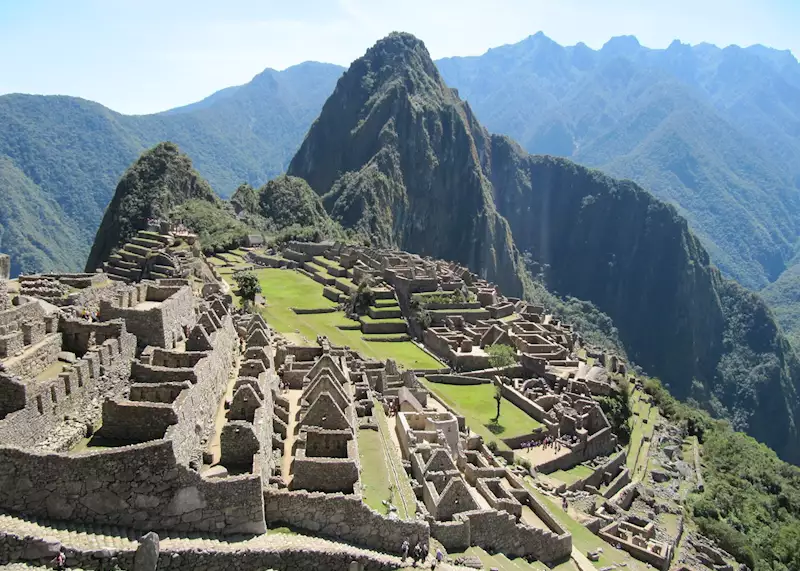
Peru has two images that appear on more Instagram feeds, travel posters, and bucket lists than almost any others in South America: the ancient citadel of Machu Picchu, shrouded in morning mist above the Urubamba Valley, and Vinicunca — Rainbow Mountain — a rippling ridge of multicoloured striped earth rising above 5,000 metres near Cusco.
Both are now firmly established on the mainstream tourist trail. Both deliver on their visual promise. And both attract the kind of crowds that can, if you aren't careful, undermine the experience. But beyond their iconic photography credentials, the two are almost entirely different kinds of attraction — and understanding those differences will help you plan a Peru itinerary that works.
What Is Machu Picchu?
Machu Picchu is a 15th-century Inca citadel built on a narrow ridge above the cloud forest of the Urubamba Valley, approximately 80 kilometres northwest of Cusco. Constructed during the reign of Emperor Pachacuti and abandoned during the Spanish conquest, the site was largely unknown to the outside world until American historian Hiram Bingham published his 1911 expedition findings.
The site covers roughly 530 square metres of carefully terraced stonework, temples, residential quarters, plazas, and agricultural terraces. The construction is extraordinary — enormous stone blocks fitted together without mortar with such precision that a piece of paper cannot be inserted between them. The Intihuatana stone (a carved ritual stone), the Temple of the Sun, and the Room of Three Windows are among the most notable structures.
Machu Picchu was designated a UNESCO World Heritage Site in 1983 and named one of the New Seven Wonders of the World in 2007. It receives approximately 1.5 million visitors per year — a number that has prompted ongoing debate about sustainable tourism and site preservation.
What Is Rainbow Mountain (Vinicunca)?
Vinicunca — commonly called Rainbow Mountain or Montaña de Siete Colores (Mountain of Seven Colours) — is a geological formation in the Cusco region at an altitude of approximately 5,200 metres (17,000 feet). The mountain's remarkable striped colouration — bands of red, yellow, green, white, and purple running across its flanks — is caused by the exposure of mineral-rich sedimentary rock through glacial retreat and erosion. Different minerals produce different colours: iron sulphide creates reds and purples, iron oxide produces yellows and oranges, chlorite creates greens, and calcium carbonate appears white.
This sounds like a chemistry lesson, but the visual result is astonishing. Vinicunca looks like a landscape from another planet — or at the very least, like a geological painting on a scale that defies easy comprehension.
For context: Rainbow Mountain was essentially unknown to tourists until around 2015, when a combination of social media exposure and the melting of a glacier that had previously covered the coloured strata brought it to global attention. Within a few years it had become one of Peru's most visited attractions.
The Experience: What to Expect
Visiting Machu Picchu
Getting to Machu Picchu involves several steps from Cusco. Most visitors take the train from either Cusco, Ollantaytambo, or Poroy to Aguas Calientes (the town at the foot of the mountain), then a bus up the winding switchback road to the site entrance. The train journey takes approximately 1.5 to 3.5 hours depending on departure point.
Entry to Machu Picchu is managed through a timed-entry ticket system that limits the number of visitors per time slot. Tickets must be purchased in advance online (often weeks or months ahead during peak season) and are not available at the gate. Different circuits allow different levels of site access.
The site itself is large. A full exploration of the main citadel takes three to four hours at a thoughtful pace. There are additional hiking options — the classic Huayna Picchu mountain (the steep peak visible behind the citadel in most photographs), Machu Picchu Mountain (higher and less crowded), and the Sun Gate (Inti Punku) for those who haven't arrived via the Inca Trail. Each of these requires a separate add-on ticket.
The experience of walking through Machu Picchu is irreplaceable. The stonework, the terracing, the scale of the site, the views into the valley — all of it combines into something that photographs genuinely cannot capture. Even jaded travellers who have seen much of the world tend to find Machu Picchu genuinely moving.
Visiting Rainbow Mountain
Rainbow Mountain is most commonly done as a day trip from Cusco. You depart very early in the morning (typically 4:00–4:30 AM) by minivan, drive approximately three hours to the trailhead at Cusipata or Pampachiri, then hike approximately 5–7 kilometres (depending on the route) to the summit viewpoint, before returning to Cusco in the evening.
The hike itself climbs roughly 400–500 metres from the trailhead to the main viewpoint and takes most visitors 1.5 to 2 hours of uphill walking. The altitude — you are hiking above 4,900 metres — makes the exertion significantly harder than it sounds. Even for fit hikers, altitude sickness is a genuine concern. Cusco itself sits at 3,400 metres, and if you have not spent several days acclimatising, the combination of altitude, cold, and physical exertion can make the climb genuinely miserable.
Horse hire is available at the trailhead for those who want to ride part of the way, and the trail is wide and well-trodden.
The viewpoint itself delivers exactly what the photographs promise. Standing at the ridge above Vinicunca with the full panorama of the coloured mountain before you — and, on clear days, a view that extends to distant glaciated peaks — is a legitimately spectacular experience.
Crowds: A Serious Consideration
Both attractions have crowd management issues, but in different ways.
Machu Picchu Crowds
Machu Picchu's timed-entry ticketing system has helped manage the worst of the crowding, but the site still sees thousands of visitors per day. Early morning arrivals (first slot, around 6 AM) offer the best experience — mist, softer light, and smaller numbers inside. By mid-morning, the main plaza and most photographic spots are crowded. Certain viewpoints (the classic "postcard" shot) involve politely waiting for others to step away.
Visiting off-season (May is quieter than July, though both are dry season) and targeting first-entry time slots significantly improves the experience.
Rainbow Mountain Crowds
Despite being a newer attraction, Rainbow Mountain gets extremely crowded. The day-trip format means that vast numbers of people arrive at roughly the same time from Cusco (all the vans leave at similar hours), creating a traffic jam of hikers on the trail. At the main viewpoint during peak hours, you may find yourself competing for photograph spots with hundreds of other visitors.
The solution — beloved by photographers and independent travellers — is to visit Red Valley (Valle Rojo), an adjacent valley that offers views of Rainbow Mountain from a different angle with dramatically fewer visitors. This requires slightly more hiking and initiative, but is worth it for those who value a more contemplative experience.
An even better strategy is to stay overnight in the area and hike to Rainbow Mountain at sunrise, before the day-trip crowds arrive. A handful of operators and local homestays near Cusipata facilitate this.
Cost Comparison
Machu Picchu
Machu Picchu entry tickets currently cost approximately USD $50–60 for adults, depending on the circuit and time slot. Additional fees apply for Huayna Picchu or Machu Picchu Mountain ($15–20 extra). The train from Ollantaytambo to Aguas Calientes costs approximately $40–80 return depending on the class and provider. The bus from Aguas Calientes to the site is around $24 return. Accommodation in Aguas Calientes (if staying overnight) ranges from $30 (dorm) to $300+ (luxury hotel).
A standard day trip to Machu Picchu from Cusco costs at minimum around $100–130 per person (train + bus + entry), and realistically $150–200 when you add food and incidentals. An overnight package including a night in Aguas Calientes runs $200–400 depending on accommodation and class of train.
Rainbow Mountain
Day trip packages from Cusco, including transport, guide, and a basic lunch, cost around USD $25–45 per person from reputable operators, or $15–25 from budget operators. Entry to the Rainbow Mountain protected area costs approximately $2–3 at the trailhead.
Rainbow Mountain is significantly cheaper than Machu Picchu — it is accessible to travellers on tight budgets for whom the train and Machu Picchu entry would be a stretch.
Which Is Better Photographically?
Rainbow Mountain is the more striking single image. The colour-banded ridge against a blue Andean sky or swirling cloud is an almost otherworldly composition. It photographs exceptionally well at golden hour — sunrise produces particularly warm tones on the mineral-coloured flanks.
Machu Picchu offers more compositional variety. The classic wide-angle shot from the Sun Gate or the terraces above the Inti Punku is iconic, but the site also rewards close-up architectural photography, misty atmospheric shots in early morning, and portrait work. It is a more complex and sustained photographic subject.
Both are extraordinary. Photographers may actually prefer Rainbow Mountain for a single image; Machu Picchu for a full day of varied work.
Can You Do Both?
Yes — and you should. From Cusco, both are accessible as day or two-day trips, and most visitors to Peru with a week in the Cusco region have time for both. A typical schedule:
- Day 1: Arrive Cusco, acclimatise
- Day 2: Cusco city exploration
- Day 3: Rainbow Mountain day trip (to build altitude tolerance before Machu Picchu)
- Day 4: Travel to Ollantaytambo via Sacred Valley
- Day 5: Train to Aguas Calientes, check in, explore town
- Day 6: Machu Picchu (first entry slot for best experience)
- Day 7: Return to Cusco by train
This sequence deliberately puts Rainbow Mountain first — the altitude exposure helps with acclimatisation for the rest of your Cusco stay, and the drive itself passes through beautiful Andean landscapes.
Who Should Prioritise Machu Picchu?
Nearly everyone visiting Peru for the first time. Machu Picchu is among the greatest human-made sites on Earth. Its history, engineering, scale, and setting are irreplaceable. This is a once-in-a-lifetime type of site that rewards every level of traveller — from backpackers staying in Aguas Calientes dorms to families splurging on the Belmond Sanctuary Lodge. No other sight in Peru competes with it as a holistic experience.
Who Should Prioritise Rainbow Mountain?
Travellers who have already seen Machu Picchu and are returning to Peru for the first time. Those drawn specifically to geological landscapes and high-altitude scenery. Hikers who want an active day trip from Cusco. Budget travellers for whom the cost of Machu Picchu is prohibitive. Photographers specifically seeking that otherworldly coloured-mountain image.
Practical Tips
For Machu Picchu:
- Book tickets at least 6–8 weeks ahead for peak season (June–August); the official booking portal is machupicchutickets.com
- Take the first entry slot to get ahead of crowds
- Hire a licensed guide for the first two hours — the site's history significantly enriches the experience
- Bring layers; the site can be cool and misty in the morning and hot by midday
For Rainbow Mountain:
- Acclimatise in Cusco for at least two full days before attempting the hike
- Start early; aim for a 4 AM departure to reach the summit before crowds
- Bring warm, windproof layers and sunscreen — conditions can change rapidly
- Consider altitude sickness medication (consult a doctor before travel)
- Don't rush; the altitude will punish you if you try to power up the mountain
The Verdict
If you can only visit one: Machu Picchu. It is simply one of the greatest heritage sites on Earth, and no amount of Instagram popularity diminishes the experience of standing among those stones in the morning mist.
But Rainbow Mountain, for all its recent fame, is not a tourist trap. It is a genuinely spectacular natural phenomenon at the edge of what feels like the world, and it offers something Machu Picchu cannot — a raw, high-altitude, geological wonder that feels entirely different from anything else Peru has to offer.
Visit both. But make sure you've spent at least two days at altitude before either.