Ask any serious overlander which roads they dream of driving, and two names appear near the top of almost every list: the Carretera Austral in Chilean Patagonia and Ruta 40 running the full spine of Argentina. Both are legendary. Both cross some of the most dramatic and remote landscapes on Earth. Both demand a certain kind of traveller — patient, flexible, mechanically competent, and comfortable with the profound emptiness of open space.
But they are utterly different experiences.
The Carretera Austral
What Is It?
The Carretera Austral — officially Ruta 7, sometimes called the Southern Highway — is a 1,240-kilometre road in Chile's Aysén and Los Lagos regions, running from Puerto Montt in the north to Villa O'Higgins in the south. It was built under the Pinochet government between 1976 and 2000, carved through some of the most geographically complex terrain on Earth: the Chilean lake district, fjords, ice fields, and ancient Valdivian temperate rainforest.
For most of its length, the Carretera Austral is a narrow, winding, unpaved (gravel) road. It passes through tiny remote villages, connects communities that were previously accessible only by boat or light aircraft, and crosses some of the most spectacular — and wet — scenery in South America. The average annual rainfall in some parts of the route exceeds 4,000 millimetres. It rains a lot.
The Route and Its Highlights
The Carretera Austral is typically driven north to south (though the reverse is equally valid):
Puerto Montt to Chaitén: The northern section requires ferry crossings (no continuous road exists through the fjord country of southern Los Lagos) and passes through lush temperate rainforest. The small ferry at La Arena–Puelche connects the road before it heads south. Chaitén — partially destroyed by a volcanic eruption in 2008 — is a haunting entry point to the Austral proper.
Chaitén to Coyhaique: The longest section and arguably the most beautiful. The road passes through the Parque Pumalín Douglas Tompkins (a spectacular private nature reserve gifted to Chile by the late conservation philanthropist Douglas Tompkins), the dramatic marble caves of Puerto Río Tranquilo on Lago General Carrera (which shares the name Lago Buenos Aires on the Argentine side), the extraordinary mountain and glacier landscape of Cerro Castillo (a UNESCO Biosphere Reserve), and eventually reaches Coyhaique — the regional capital and the largest town on the route.
Coyhaique to Cochrane: This section includes Villa Cerro Castillo, the Río Baker (one of the most powerful rivers in South America, setting for a major hydroelectric controversy), and the small town of Cochrane, a useful supply stop.
Cochrane to Villa O'Higgins: The most remote section. Beyond Cochrane, the road becomes increasingly rough and isolated. Villa O'Higgins is the southern terminus, a village of a few hundred people at the edge of the Southern Patagonian Ice Field. From here, a boat and foot crossing connects to the Argentine town of El Chaltén (and the Fitz Roy massif) via a route that involves walking through dense forest and crossing the border at a wilderness point — one of South America's great adventure travel routes.
How to Travel It
Self-drive: The most popular approach. A 4WD vehicle is strongly recommended (the gravel roads are rough and river crossings occur); a 4WD with a spare tyre is essential. Petrol stations are widely spaced — fuel range must be calculated carefully. Rental 4WDs are available from Puerto Montt and Coyhaique. Chilean rental companies increasingly allow dropping the vehicle at the opposite end to avoid backtracking.
Cycling: The Carretera Austral is among the world's great cycling routes. Touring cyclists arrive in numbers each summer (November–March) and spend three to six weeks riding the full length. The combination of dramatic scenery, low traffic, and a genuine sense of adventure makes it a bucket-list cycling destination. The downside: the weather. Rain, wind, and cold are facts of Patagonian life.
Hitchhiking: Slower but still practised. Traffic is light in the remote sections and waits can be long, but the local culture is generally hospitable and the experience of hitching into Villa O'Higgins or across the Río Baker has its own romance.
Public bus: Possible but patchy. Services connect major towns (Chaitén, Futaleufú, Puyuhuapi, Coyhaique, Cochrane) but are infrequent and do not cover every scenic section.
Best Season
November to March is the prime season: longer days, warmer temperatures, and better road conditions. January and February are peak: more traffic, fuller campsites, and slightly less dramatic skies. November, December, and March offer better solitude and often spectacular weather.
The route is passable in winter (April–October) for experienced overlanders in appropriate vehicles, but some services close and weather conditions can be genuinely challenging.
Ruta 40
What Is It?
Ruta Nacional 40 is Argentina's longest road, running approximately 5,194 kilometres from Cabo Vírgenes — the southernmost point of the Argentine mainland at the Atlantic coast near Río Gallegos — north to La Quiaca on the Bolivian border in Jujuy Province. It parallels the Andes through the full length of the country, passing through eleven provinces and nine national parks.
Unlike the Carretera Austral's continuous narrative — a single road with a single story — Ruta 40 is an epic that changes character completely as it moves through radically different regions. The route through Patagonia is fundamentally different from the wine country sections of Mendoza, which are again different from the Andean northwest near Salta and Jujuy.
The Route and Its Highlights
Patagonian Ruta 40 (south): This is the section most associated with the road's mythological status. Between El Calafate (gateway to the Perito Moreno Glacier and Los Glaciares National Park) and Bariloche in the Lake District, Ruta 40 cuts through the steppe of Santa Cruz and Neuquén provinces. The scenery here is austere and magnificent: flat pampas extending to a distant Andean horizon, guanacos in herds of hundreds, condors circling above, and almost no traffic or human presence for hundreds of kilometres. The road in this section is partly paved and partly gravel (ripio), and the isolation is extreme.
Key highlights of the Patagonian section:
- El Chaltén and Fitz Roy: Just off Ruta 40 (or directly connected via the road from El Chaltén to Tres Lagos), the jagged granite towers of the Fitz Roy massif are among the most recognisable mountains in the world. World-class trekking in Los Glaciares National Park.
- El Calafate and the Perito Moreno Glacier: One of the world's greatest glaciological spectacles — a river of blue ice advancing into Lago Argentino and periodically calving with extraordinary force.
- Gobernador Gregores and the desolate steppe: The long, empty, wind-scoured driving between towns in southern Patagonia is not universally loved, but it has its advocates.
Lake District Ruta 40: As the road enters Neuquén and Río Negro provinces, the character changes entirely. The Lake District — accessible from Bariloche — offers a gentler, Swiss-influenced landscape of glacial lakes, snowcapped volcanoes, and pine forest. The Ruta de los Siete Lagos (Route of the Seven Lakes) between San Martín de los Andes and Bariloche is one of the most scenic drives in South America and is technically part of the Ruta 40 network.
Wine Country (Mendoza): Ruta 40 passes through Mendoza Province, the heart of Argentina's wine country. The road here is fully paved, the services abundant, and the scenery dominated by vine-covered foothills and the snow-capped Andes backdrop. A very different Ruta 40.
Northwest Ruta 40 (north): Through Salta and Jujuy, Ruta 40 enters the high-altitude puna (Andean plateau) — the world at 3,500–4,500 metres, with adobe villages, llama herds, coloured mountains, and the archaeological legacy of the Inca and pre-Inca cultures. This is the most culturally rich section of the route.
How to Travel It
Few people drive Ruta 40's full length. The most common approach is to cover specific sections:
- A southern Patagonia loop: Bariloche → Esquel → El Chaltén → El Calafate → Ushuaia
- A northwestern cultural route: Mendoza → Salta → Jujuy → Quebrada de Humahuaca
Self-drive in a rental car or campervan is the most practical approach for most sections. The fully paved sections (wine country, Lake District, northwest) are manageable in a standard car. The gravel sections of southern Patagonia benefit from a 4WD.
Head-to-Head Comparison
| Factor | Carretera Austral | Ruta 40 |
|---|---|---|
| Length | 1,240 km | 5,194 km |
| Surface | Mostly gravel | Mixed paved/gravel |
| Scenery | Fjords, glaciers, rainforest | Steppe, mountains, lakes, desert |
| Infrastructure | Sparse but developing | Variable by region |
| Best vehicle | 4WD strongly recommended | Depends on section |
| Cycling potential | Outstanding | Good (specific sections) |
| Crowds | Low to moderate in season | Very low in remote sections |
| Cultural interest | Lower | Higher (northwest section) |
| Drama of isolation | Extreme | Extreme (Patagonian section) |
| Planning complexity | High (ferries, fuel) | High (vast distances, fuel) |
Who Should Drive the Carretera Austral?
- Travellers primarily motivated by raw, wet, green Patagonian scenery
- Cyclists seeking a world-class long-distance cycle touring route
- Those who want a single focused overlanding narrative
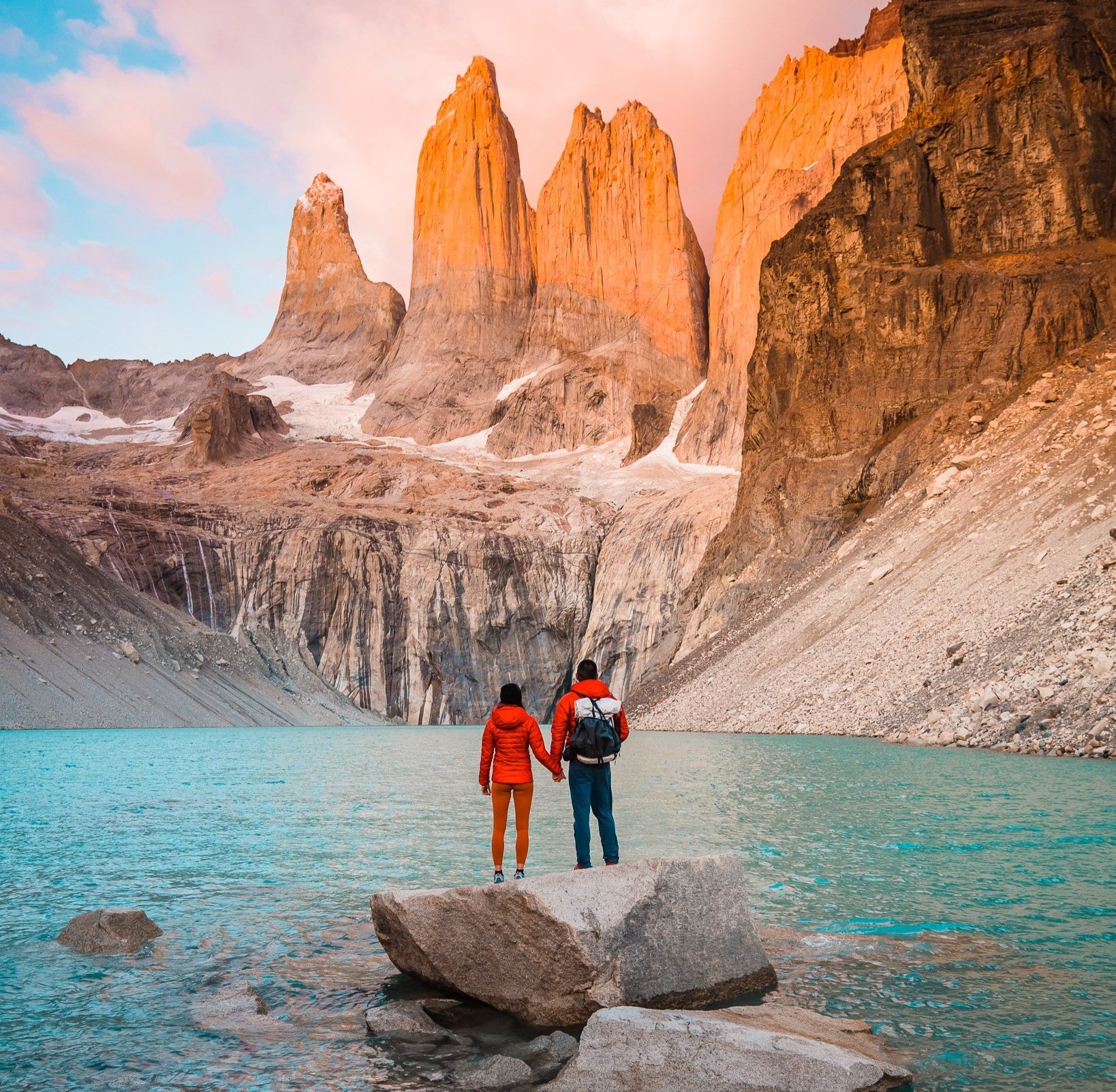
- Anyone combining southern Chile with a Torres del Paine circuit
- Travellers comfortable with rain and unpredictable weather
- Those whose itinerary includes the connection to El Chaltén via Villa O'Higgins
Who Should Drive Ruta 40?
- Travellers wanting Argentina's iconic road trip experience
- Those combining Patagonia with the wine regions and northwest Argentina
- Road-trippers who want vast, sky-filling emptiness and endless steppe
- Overlanders doing extended South American journeys who want a spine route
- Motorists comfortable with occasional extreme fuel management
Can You Do Both?
Many South American overlanders do both in the same trip: the Carretera Austral in Chile and the Patagonian section of Ruta 40 in Argentina are geographically complementary and can be combined via the several border crossings that connect the two countries (Paso Futaleufú, Paso Río Mayer, and others). Starting in Puerto Montt, driving south on the Carretera Austral to Villa O'Higgins, crossing to El Chaltén, and then driving north on Ruta 40 to Bariloche before re-entering Chile is a coherent and rewarding loop.
The Verdict
Both roads deliver experiences that genuinely justify the hype. The Carretera Austral is arguably the more beautiful single-road experience in South America — its fjords, glaciers, and rainforest density are unlike anything on the Argentine side. But it is also wetter, narrower, and more logistically demanding.
Ruta 40's Patagonian section offers the elemental drama of the steppe — the wind, the emptiness, the sheer scale — in a way that can be almost meditative. And its northern sections add cultural layers that the Carretera Austral simply cannot match.
For a pure overlanding experience of the greatest intensity: Carretera Austral. For the quintessential long-haul South American road trip: Ruta 40. If you have the time and the vehicle: both.