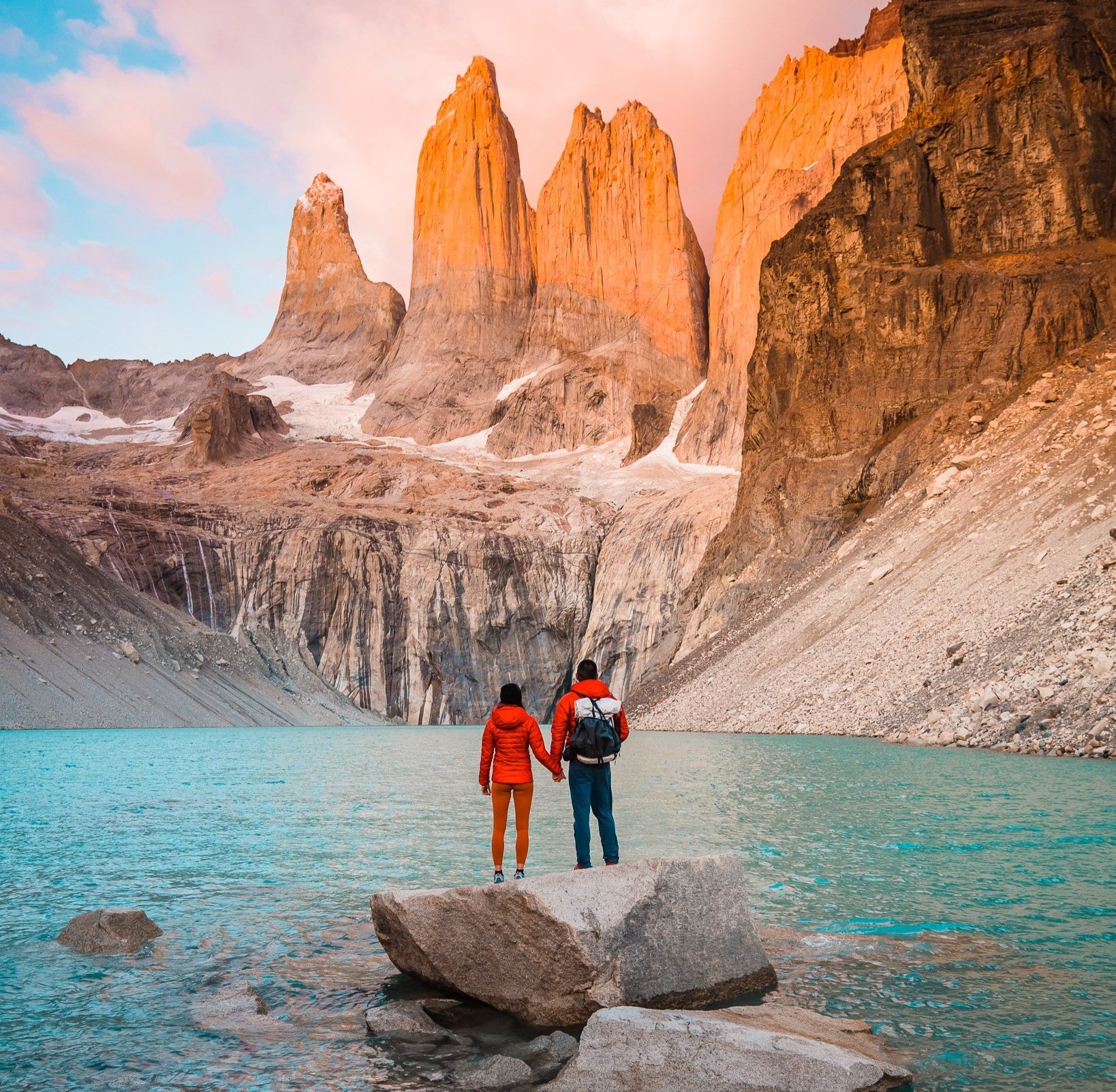
Torres del Paine National Park in Chilean Patagonia is one of the world's great hiking destinations. The jagged granite towers, electric-blue glaciers, emerald lakes, and sweeping steppe landscapes combine to create scenery of almost absurd drama. It is the kind of place where experienced travellers — people who have seen much of the world — still reach for their cameras every ten minutes.
At the heart of a Torres del Paine visit is a choice between two great treks: the W Trek and the full O Circuit. Both are world-class. Both are physically demanding. And both will give you memories that last a lifetime. But they differ significantly in length, difficulty, cost, logistics, and what you actually see.
This guide covers everything you need to know to choose between them.
The Routes at a Glance
The W Trek
The W Trek gets its name from the W-shaped route it traces across the central portion of Torres del Paine. It covers approximately 80 kilometres (50 miles) and is typically completed in four to five days. The route connects three of the park's most iconic destinations: the Torres (the three granite towers themselves), the Valle del Francés (a dramatic valley surrounded by hanging glaciers and knife-edged peaks), and the Grey Glacier (one of the most accessible sections of the Southern Patagonian Ice Field).
Most hikers travel the W from east to west, starting at the Refugio Las Torres base camp and ending at Lago Grey, before catching a boat or hiking back to the park administration area. A smaller number do it west to east.
Accommodation along the W is well-serviced. The route passes through a series of refugios (mountain huts) and campsites operated by CONAF and two private concessionaires (Vertice Patagonia and Las Torres). Most trekkers sleep in a combination of refugio dorm beds and tent camping, though fully self-sufficient wild camping is also possible with a permit.
The O Circuit
The O Circuit — also called the Full Circuit or the Q — is the complete loop that circumnavigates the Torres del Paine massif. It is typically 110–130 kilometres (68–80 miles) depending on the variant walked, and most hikers complete it in eight to ten days.
The O Circuit includes the entire W as its southern section, then adds the "back" of the circuit: a remote, wild, and significantly more demanding stretch through the northern and western parts of the park. This back section passes through far fewer tourist facilities, sees dramatically fewer people, and traverses the most remote terrain in the park.
The most challenging — and spectacular — part of the back section is the John Gardner Pass (Paso John Gardner), at approximately 1,241 metres, which offers one of the most extraordinary views in all of Patagonia: a panoramic vista over the Grey Glacier and the vast Southern Ice Field stretching to the horizon.
Scenery: What Do You Actually See?
W Trek
The W covers all three of the park's signature highlights. The Mirador Las Torres (the viewpoint at the base of the towers) is a genuine bucket-list moment — a turquoise lake surrounded by sheer granite walls, with the three towers rising above. Valle del Francés offers glaciers, hanging waterfalls, and the dramatic Cuernos del Paine peaks. Grey Glacier is massive, blue, and otherworldly.
You will not leave the W feeling shortchanged on scenery. These are among the finest landscapes in South America, and most travellers return from the W convinced they have seen something extraordinary.
O Circuit
The O Circuit includes all of the above — plus the back section. And the back section is, to many experienced hikers, the most beautiful part of the entire park.
The John Gardner Pass view is genuinely jaw-dropping. You stand at the highest point on the circuit and look down over a frozen world that stretches to the horizon — a river of ice forty kilometres wide, punctuated by crevasses and calving towers of blue ice. Below the pass, you descend through lenga beech forest draped in old-man's-beard lichen to the remote refugio at Dickson.
The northern lakes — Dickson, Los Perros, and Pingo — are pristine and largely tourist-free. The campsites on the back section feel genuinely wild. Wildlife — condors, guanacos, foxes — is more abundant in these remote valleys.
If the W is a highlight reel, the O Circuit is the full film.
Scenery winner: O Circuit — though the W covers all the iconic viewpoints.
Difficulty
Both treks are rated moderate to challenging and require reasonable fitness. Neither requires technical mountaineering skills.
W Trek
The W's daily distances range from about 12 to 25 kilometres, with significant elevation gain on the days visiting the Torres (a steep 800-metre climb from the refugio to the mirador) and Valle del Francés. The terrain alternates between well-maintained trails and rougher rocky sections.
Fit walkers with experience of multi-day hiking in mountain terrain will find the W challenging but not overwhelming. The availability of refugios every day means you carry only a day pack if you pre-book accommodation and meals — a significant weight advantage.
O Circuit
The back section of the O Circuit is substantially harder. The segment from Campamento Paso to Refugio Grey via the John Gardner Pass involves a steep, often muddy scramble over tree roots and loose rock on both sides of the pass. In wet conditions — which are frequent in Patagonia — this section can be genuinely dangerous, and it requires care.
Daily distances on the back section are longer, and the terrain is rougher and less maintained. Campamento Los Perros, on the approach to the pass, has no refugio — only tent camping — meaning you must carry a full pack with tent, sleeping bag, and food for this section regardless of your preferred accommodation style elsewhere.
Wind and weather in Patagonia are notoriously unpredictable. The full circuit, which takes more days, exposes you to more weather events. Multi-day storms that pin tents to the ground are not unusual.
Difficulty winner: O Circuit is significantly harder, particularly the back section.
Time Required
W Trek
Four to five days is the standard. Fit hikers doing long days can complete it in three (though this is rushed and not recommended). Some people spend six days to be more relaxed about the hiking.
O Circuit
Eight to ten days is standard. Fewer days means gruelling daily distances; more days is ideal if your schedule allows. Most independent travellers doing the full circuit budget nine nights.
The time commitment of the O Circuit makes it impractical for travellers on tight schedules. If you have fewer than seven full days in the park, the W Trek is the practical choice.
Logistics and Booking
Park Permits and Reservations
Torres del Paine requires an entrance permit (currently around CLP 21,000 — roughly USD $25 — for adults). For both treks, you must pre-register your intended route with CONAF (the park administration) and book your campsites and refugios well in advance — particularly for peak season (November to March).
Demand for campsites on both routes has increased dramatically over the last decade. Peak-season reservations for the W Trek can sell out three to four months in advance. The O Circuit back section is less competitive — far fewer people do the full circuit — but Campamento Los Perros and Campamento Dickson still book quickly.
Online booking is available through the Las Torres and Vertice Patagonia websites. The CONAF system handles the free campsites.
Getting There
Most hikers fly into Punta Arenas or Puerto Natales. Puerto Natales (about 110 km from the park entrance) is the main gateway town, with ample gear shops, accommodation, and shuttle buses to the park. The shuttle from Puerto Natales to the park takes about two hours.
For the W Trek, most hikers start at the Laguna Amarga entrance (for the Torres trail) or at Pudeto (for the catamaran to Refugio Paine Grande). For the O Circuit, most begin at the Laguna Amarga entrance and walk counterclockwise to tackle the back section in its traditional direction (crossing the John Gardner Pass west to east, descending from it with the glacier view in front of you).
Cost
W Trek
A W Trek with a mix of refugio nights and tent camping — including park fees, shuttle transfers, and the Río Serrano catamaran crossing — typically costs:
- Budget (camping only, self-catering): $150–250 for the trek itself (excluding gear, flights to Punta Arenas, and Puerto Natales accommodation)
- Mid-range (mix of refugio dorms and camping, some meals): $400–700
- Comfort (refugio dorms with meals included): $800–1,200
O Circuit
The O Circuit adds additional camping nights on the back section where there is no refugio accommodation. Since you must carry a tent and food for at least two nights on the back section, gear costs matter more.
- Budget (camping-heavy): $200–350 for the trek itself
- Mid-range: $500–900
- Comfort (as much refugio use as available): $900–1,400+
Note: All prices are trek-only estimates and exclude flights, Puerto Natales accommodation, gear rental, and food brought from town.
Weather and Best Season
Patagonian weather is famously unpredictable. Even in the height of summer (December–February), you can experience four seasons in a day. Wind is constant and can be ferocious. Rain can arrive without warning.
Peak season (November–March): The warmest months, most daylight, and the highest crowds. January and February are the busiest. November and March are excellent — fewer people, often stable weather, wildflowers in November, golden autumn colours in March.
Shoulder season (October, April): Cooler, windier, and wetter, but trails are quieter. October can have beautiful clear days and snow dusting the peaks. April's autumn colours are spectacular.
Off-season (May–September): The park is technically open but many refugios close, weather is harsh, and some trails may be closed due to snow. Not recommended for the O Circuit. Experienced winter hikers do the W in June–August with proper gear.
Both treks are best planned for November to March. If you are doing the O Circuit specifically for the John Gardner Pass view, choose a window with historically lower wind — mid-December to mid-February tends to be the most reliable, though nothing is guaranteed.
Who Should Choose the W Trek?
- Travellers with limited time (four to seven days in the park)
- Those who want the iconic highlights without the gruelling back section
- Less experienced hikers or those not confident in technical mountain terrain
- Anyone who prefers refugio sleeping over tent camping
- Travellers booking relatively late (less lead time needed than full O Circuit)
- Families with older children capable of multi-day hiking
Who Should Choose the O Circuit?
- Experienced hikers who want the complete Patagonia experience
- Those with eight to ten days available
- Travellers who value solitude and wilderness over convenience
- Anyone for whom the John Gardner Pass view is the primary objective
- Hikers comfortable with variable weather, carrying full packs, and camping in remote conditions
- Return visitors who have already done the W and want more
A Note on Guided vs Independent Hiking
Both treks can be done independently (the more popular choice) or with a guided company. Independent hiking requires more planning, gear, and navigation confidence, but is cheaper and more flexible. Guided companies handle all logistics but cost significantly more — often $2,000–4,000 per person for a guided W Trek.
For fit, experienced hikers, independent trekking on the W or O is entirely feasible. The trails are well-marked on the main route, and infrastructure on the W is excellent.
The Verdict
The W Trek is one of the finest multi-day hikes in South America. Its combination of iconic scenery, manageable logistics, and reasonable time commitment makes it accessible to a broad range of travellers. If you have four to five days and want to see Torres del Paine's greatest hits, the W delivers everything it promises.
The O Circuit is for those who want the complete experience. It is harder, longer, more expensive to reach logistically, and more demanding of preparation — but the back section's raw wilderness, the solitude of the northern lakes, and the transcendent view from the John Gardner Pass elevate it into a different category of adventure. Many hikers who have done both will tell you the back section was the highlight of their entire Patagonia trip.
If time and fitness allow: do the O Circuit. If time is short or you are not yet a seasoned multi-day hiker: the W Trek is still world-class. There is no wrong answer in Torres del Paine.